Abstract
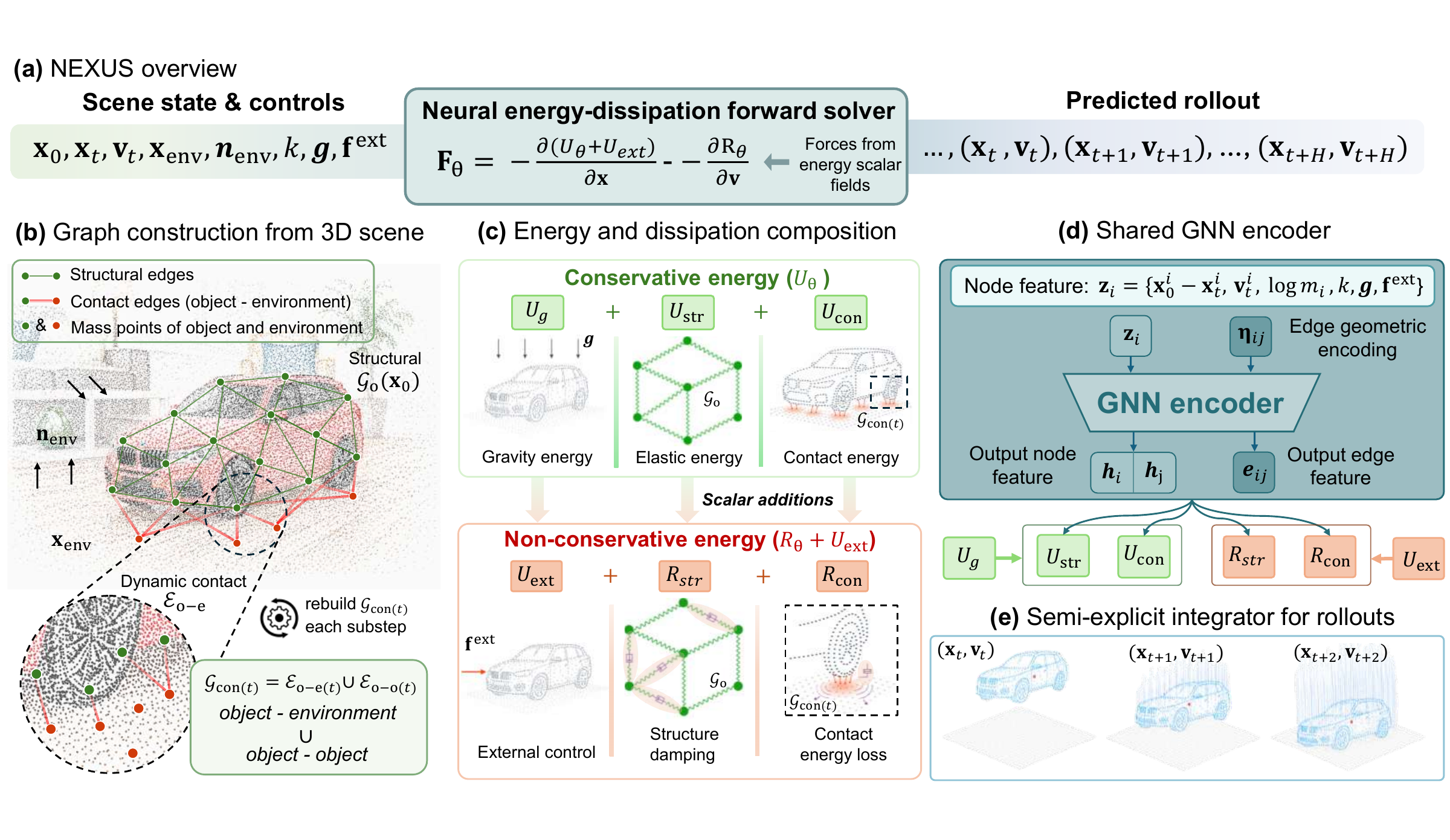
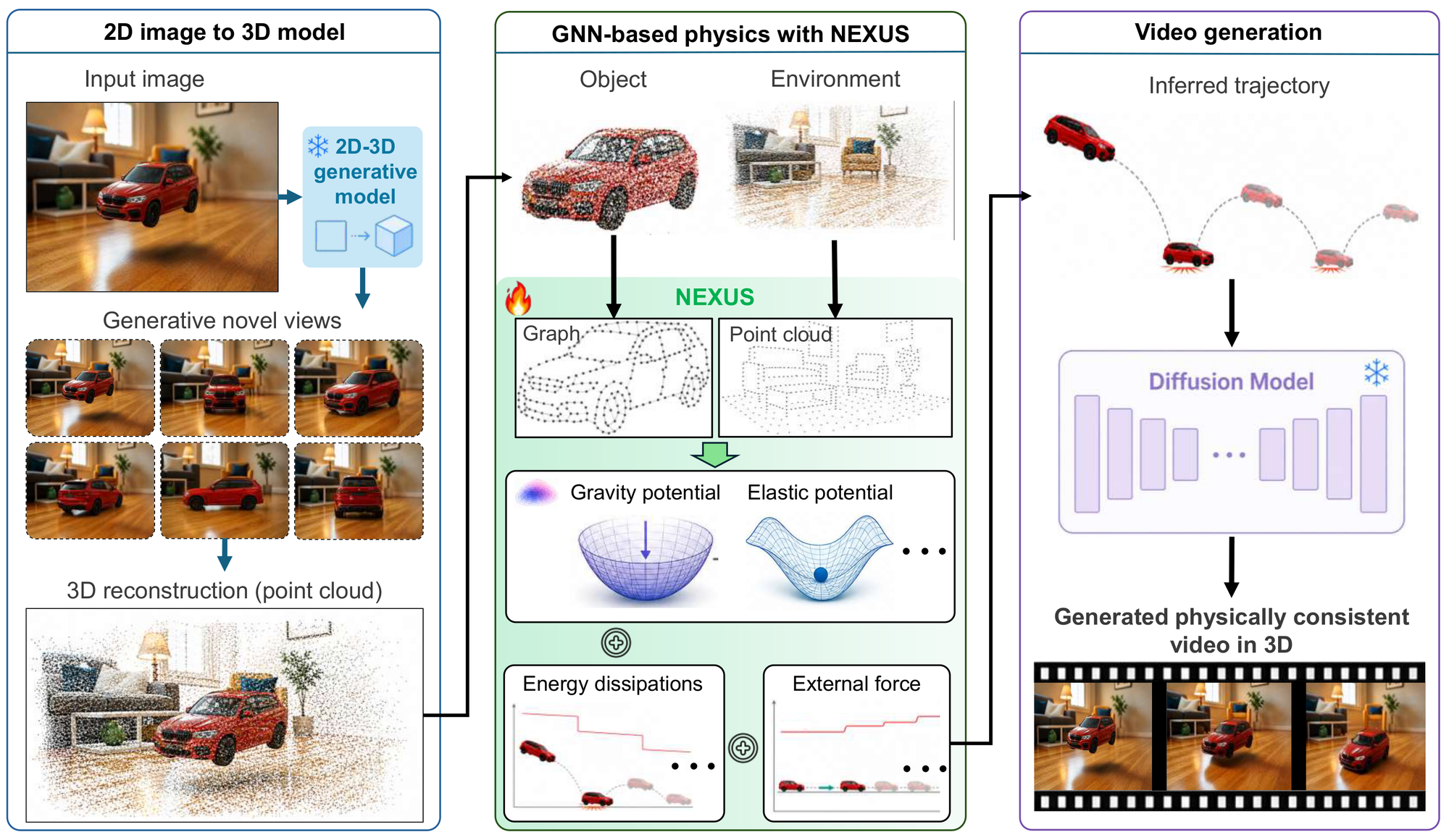
Physics-grounded video generation requires controllable 3D object dynamics that remain physically consistent under contact, deformation, and external forcing. Existing trajectory-based methods provide physical control, but they often model isolated physical effects rather than deriving dynamics from a unified physical structure, making it difficult to compose conservative and non-conservative effects while preserving controllability in contact-rich 3D scenes. We present NEXUS, a neural energy-field framework for contact-rich 3D object dynamics. NEXUS represents each object as a structural graph and constructs dynamic contact graphs for object–object and object–environment interactions. Inspired by Hamiltonian Neural Network (HNN) energy-based dynamics, NEXUS formulates motion through scalar energy and dissipation terms rather than directly predicting states or accelerations. Conservative effects, such as gravity and elastic deformation, are composed as additive energy terms over the scene. To handle non-conservative effects beyond standard HNNs, NEXUS learns dissipation functions for damping and impact-induced energy loss. Forces are derived by differentiating the energy and dissipation functions and rolled out with a multi-substep semi-implicit integrator. NEXUS provides a stable and controllable physics reasoning module for contact-rich 3D object dynamics, improving long-horizon accuracy over representative learned and physics-structured dynamics baselines across controlled rollouts with varying mechanical properties and physical-effect compositions.